

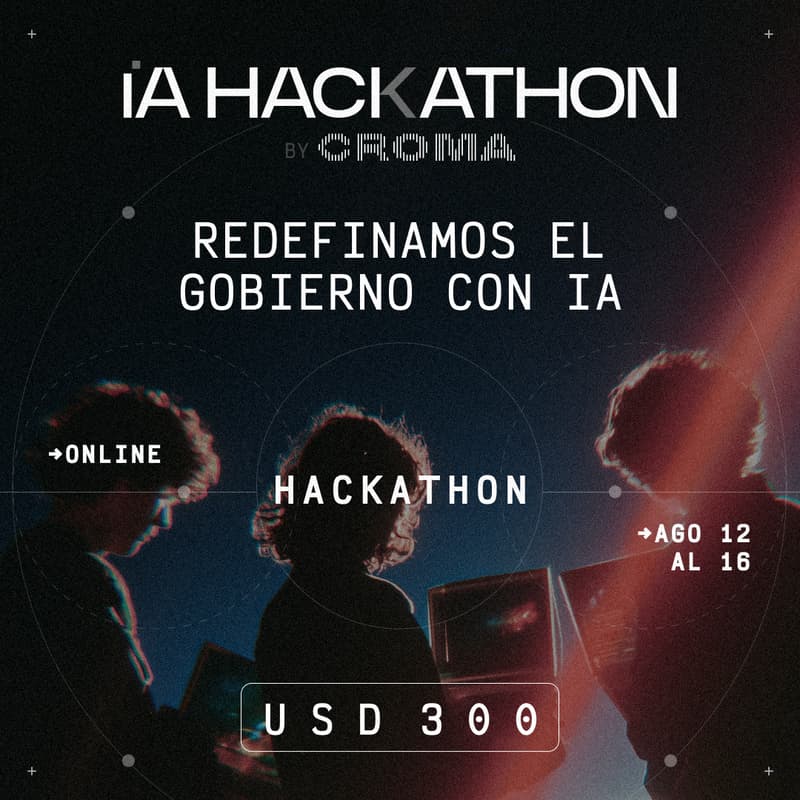
The GOV-TECH AI hackathon closed on August 16. Twelve teams from Colombia, Peru and Mexico shipped a working product in five days, every one of them built on the Croma Platform through the API or MCP. The winner is Centinela, by Adrian Issac: 300 dollars in cash and 6 months of Croma free to keep building it.
The winner: Centinela#
Centinela watches Colombian public procurement without anyone asking it to. Every two hours it checks the new processes belonging to the entities and contractors you have flagged, and for each one it chains six official sources: SECOP, RUES, Supersociedades, Rama Judicial, Procuraduría and Contraloría. What comes back is not a report. It is a verdict with the chain of evidence cited.
What won it is that the same analysis reads two ways. To a small business it is an opportunity: this process is winnable and there is little competition. To a citizen it is a red flag: single bidder, company incorporated two months ago, interadministrative contract. One engine, two products, and the one that pays funds the one that watches.
It also finds signals nobody sees reading contracts one at a time, like award concentration around a single supplier or shared legal representatives between supposed competitors. And it does not stop at the finding: it drafts the freedom-of-information request under Ley 1755, the evidence dossier and the social thread.
Try it at centinela.aido.lat or watch the video.
The twelve projects#
Alphabetical, not ranked: there was only one prize.
| Project | Team | What it does | Links |
|---|---|---|---|
| Análisis de negocios con gobierno, línea automotriz | jhacardonahe (Colombia) | SECOP intelligence aimed at the automotive sector: what the state buys, and who it buys from. | Product · Video |
| AUTODATA | Brayan Ccarita Cruz, Joaquín Chaparro, Carlos Gamonal, José Díaz and José Hurtado (Peru) | Telegram bot that checks a used car and its seller against six Peruvian sources, then returns a verdict, a fair price and a negotiation script. | Product · Video |
| Centinela | Adrian Issac (Peru) | Autonomous agent that watches Colombian public procurement and issues opportunities and red flags with cited evidence. | Product · Video |
| Contraparte | José Ramírez (Mexico) | Due diligence on companies and people across Colombia, Mexico and Peru, with every data point tied back to its official source. | Product · Video |
| Creva Score | Luis Cárdenas (Colombia) | An explainable score for women entrepreneurs with no credit history, built from official records instead of assumptions. | Video |
| CROMLAFT | Andrés Ochoa (Colombia) | Presented on video. | Video |
| Croma Legal Intelligence | PUCP team (Peru) | Presented on video. | Video |
| GraphAudit | Andrés Solano, Juan Sebastián González, Natalia Casallas and Sebastián Herrera (Colombia) | Corporate control map: given a contracting entity, which individuals concentrate control over its suppliers, and in what order they are worth reviewing. | Video |
| Mallanet Verify | José Ramón García (Colombia) | MCP server that screens an NGO's volunteers against public sources and stores a Pass, Alert or Fail report. | Product · Video |
| RASTRO | Naren Santiago Rojas Sánchez (Colombia) | A risk file on any contractor or entity, crossing six sources in parallel and citing the source and lookup date for each. | Video |
| TRAZA | Emily Lenis (Colombia) | Research agent that turns a plain-language question about public procurement into an auditable case file. | Product · Video |
| Trazo | Jesús Flórez (Colombia) | Interactive graph of public procurement that surfaces entities, suppliers, contracts and sanctions live. | Product · Video |
What we took away#
Seven of the twelve projects went after public procurement, and none of them settled for searching contracts. They all did the same thing: cross the corporate registry, the financials and the disciplinary records against the process, because a tax ID on its own says nothing and a crossed one does. That is exactly the operation that used to cost weeks of integration work and is now a single call.
Something else showed up that we did not expect: almost every team wrote its own counter-explanation. GraphAudit states that it prioritizes review rather than accuses. RASTRO cites the source and the date on every finding. Creva Score decides not to penalize anyone for what is missing from a voluntary registry. Once data becomes easy to cross, the judgment used to read it stops being a detail and becomes the product.
Thanks to all twelve teams for five days of real work. If you want to build something like this, start with the documentation, browse the sources, or try the tools without writing a line of code.